
Every boss, in the order you meet them
The roster, and how we know it
The trophy list awards a trophy per story boss, which makes it an unusually reliable roster: nine named bosses plus the prologue Cyclops and The Katergaris. Ten named encounters in total, with three of them being the Stymphalian Birds fought separately.
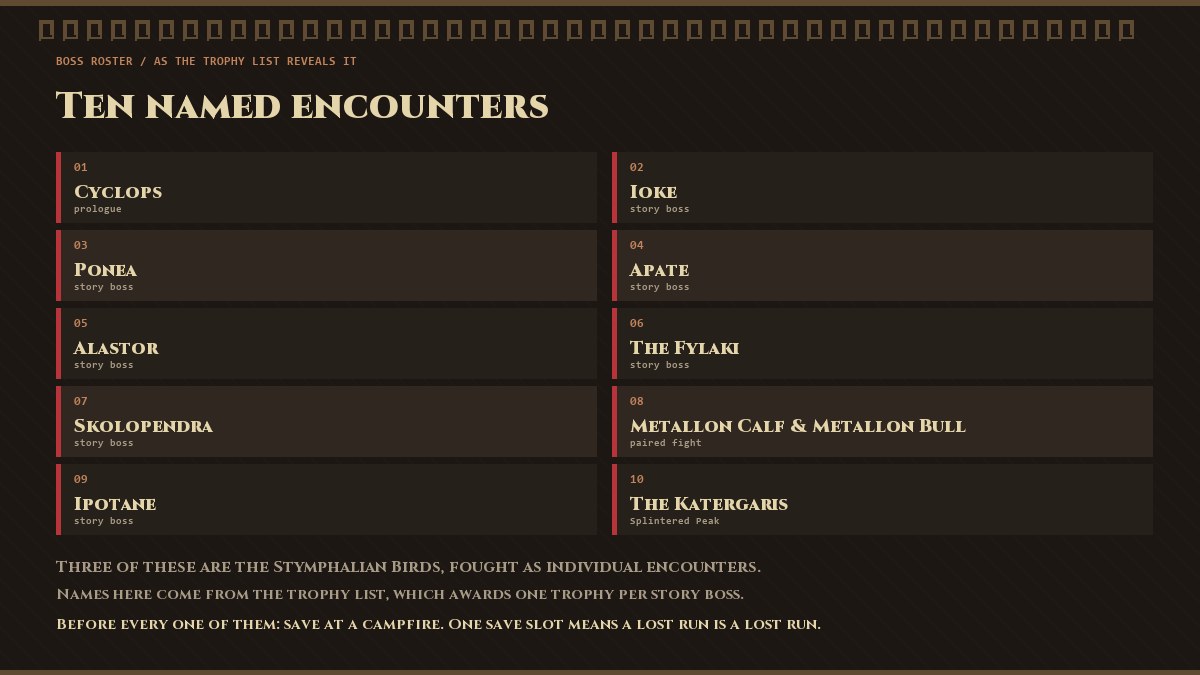
| # | Boss | Where it sits |
|---|---|---|
| 1 | Cyclops | Prologue, outside Sparta |
| 2 | Ioke | Story boss, Stymphalian Bird |
| 3 | Ponea | Story boss, Stymphalian Bird |
| 4 | Apate | Story boss, Stymphalian Bird |
| 5 | Alastor | Story boss, at the Oenus Vineyard |
| 6 | The Fylaki | Story boss, an ancient entity |
| 7 | Skolopendra | Story boss, sea creature |
| 8 | Metallon Calf & Metallon Bull | Paired fight |
| 9 | Ipotane | Story boss |
| 10 | The Katergaris | Splintered Peak; drops the Treasure Map |
Preparation that actually matters
Three things, in order of how much they change the fight.
1. Save at a campfire immediately before. There is one save slot and no New Game Plus. A boss attempt that ends badly with two hours of unsaved progress behind it is a self-inflicted wound.
2. Know which tree you have bought into. The three trees are offence, defence and movement, and they all draw on the same red orbs. A player who spread orbs evenly across all three is weaker at every boss than a player who committed to one. Commit before the fight, not during it.
3. Bring the right Gift of Olympus family. The Gifts split into ranged, melee-combo and mobility families. A ranged gift lets you keep attacking through a phase where melee would be suicide; a melee gift covers the range gap the spear leaves. Check what you have equipped before you walk in — the game does not prompt you.
Fight-by-fight notes
Cyclops (prologue)
The tutorial boss and the one that teaches the spear's reach. Keep distance, punish the recovery, do not stand in front of it. It exists to make you use the spear's length before the game starts asking for it.
Ioke, Ponea, Apate (Stymphalian Birds)
Three separate encounters with the same family of enemy. What works on one works on the others, so treat the first as the lesson. They are mobile and punish greed; short commitments beat long combos.
Alastor (Oenus Vineyard)
The demon at the abandoned winery, and the first fight where the arena itself is a factor. Watch the space you have rather than the boss's health bar — if you have backed into a corner, the fight has already gone wrong.
The Fylaki
Described as an ancient malevolent entity, and the encounter where the shield earns its slot. Block stability and parry timing matter more here than raw damage, which makes it the fight that punishes an all-offence build.
Skolopendra
A sea creature, so the fight's geometry is different: reach and positioning matter more than the combo tree. A ranged Gift of Olympus is at its most useful here.
Metallon Calf & Metallon Bull
The only paired fight on the list. Two targets means two attack windows to read, which is the situation Erebus Mode punishes hardest. Kill order matters; pick the one whose attacks you can read least and remove it first.
Ipotane
Fought while working through the cult storyline. By this point the game assumes you have a real build, so this is where an unfocused orb spend shows up.
The Katergaris (Splintered Peak)
The final named encounter and a trophy gate: killing it drops the Treasure Map for Rightful Owners, which you then carry back to Kerkopes in Laconian Woods. Do not leave the region without the map.
In Erebus Mode
Every fight above becomes a pattern test rather than a damage race, because one hit kills both ways. The habit that saves runs is treating the first attempt as reconnaissance: watch the telegraph, do not try to win. A boss you have watched is a boss you can learn; a boss you have only traded hits with is a wall.
What this page is not
It is not a move-by-move counter guide. Publishing exact attack timings for ten encounters without frame data would mean inventing numbers, and a guide that invents timings is worse than no guide. What is here is the roster, the order, the preparation, and the specific traps — the parts that are stable.
Hermes Mode: rules, unlock code and split routingErebus Mode: surviving when every hit killsAll 594 collectibles, ranked by regionPlatinum roadmap: 36 trophies, one playthroughSpear, shield and how attachments actually upgradeThree skill trees, one orb budgetGifts of Olympus and what each family doesOne save slot, campfires only, and a mode you cannot changeAll 20 guides →