
Erebus Mode: surviving when every hit kills
What Erebus Mode is
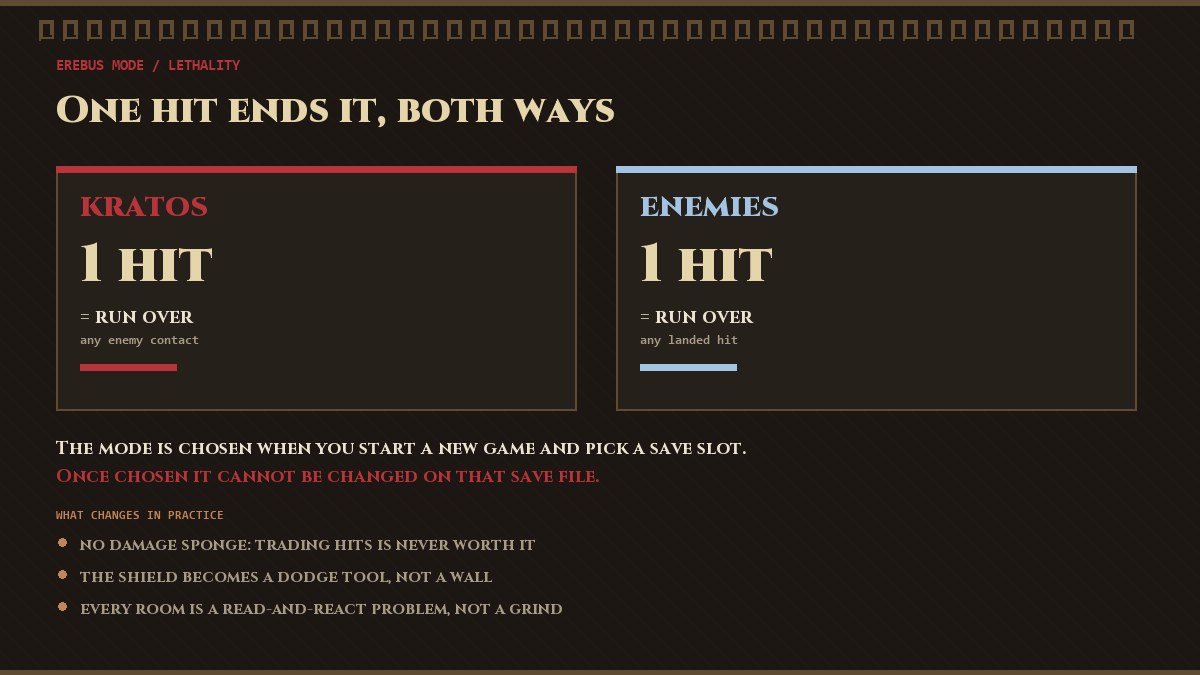
Erebus Mode is the one-hit mode in the 16 November 2026 patch. The rule is symmetrical and stated plainly by the developers: both you and your enemies fall in a single hit.
That symmetry is the whole design. It is not a "hard mode" with inflated enemy health — it is a mode where every encounter collapses to a single exchange. Your health bar stops being a resource and becomes a pass/fail condition.
The mode lock applies here too
Mode selection happens when you start a new game and choose a save slot, and the choice cannot be changed for that file. So an Erebus run is an Erebus run; you cannot soften it when a boss walls you, and you cannot convert a finished standard file into one.
Combined with the save system — one slot, manual saves at campfires only — a careless Erebus session can cost you real progress. Save before every room you have not solved.
What actually changes in play
Erebus does not add new enemies or new attacks. It changes the value of everything you already do.
| Element | In a normal run | In Erebus |
|---|---|---|
| Trading hits | Often acceptable | Never acceptable, it ends the run |
| Shield | A wall you can hide behind | A timing tool; a held block invites a guard break |
| Healing pickups | A buffer | Irrelevant, there is nothing to heal |
| Long combos | Damage uptime | Exposure; every extra frame is a risk |
| Enemy count | Attrition | A puzzle; two enemies means two reads |
| Boss fights | Sustained execution | Pattern memorisation, then a clean answer |
The practical shift is from managing a pool to reading a room. In a normal run you can absorb a mistake and recover. In Erebus a mistake is the run.
Habits that keep an Erebus run alive
- Stop attacking first, watch second. Your first pass through a new room should be observation. You cannot learn a telegraph by dying to it repeatedly with a 20-minute walk back.
- Treat the shield as a parry, not a wall. Holding block against a multi-hit string is how one-hit modes kill players who are used to tanking.
- Pull one enemy at a time whenever the room allows it. Two simultaneous attack windows is a coin flip.
- Save at every campfire, then save again after anything you would hate to redo. The save system is the real difficulty setting in this mode.
- Do not buy offence first. With one-hit lethality, the offensive tree shortens fights but does not stop you dying; the defensive and movement trees buy you the space to not be hit.
- Learn the boss before you fight it. Watch the first attempt as a scouting run, not as an attempt to win.
Which tree to buy into first
The three skill trees are offence, defence and movement, and all of them draw on the same red orbs. In Erebus the value ordering inverts compared with a normal run.
- Movement first: air control and dash distance are how you leave an attack's reach. Mobility is defence in a mode where contact is lethal.
- Defence second: parry windows and block stability are the difference between a read and a guess.
- Offence last: killing faster matters less when everything dies in one hit anyway. The value of offence in Erebus is reach — hitting without entering the enemy's attack range.
That last point is the one most players miss. A longer weapon is a defensive upgrade in a one-hit mode.
The bosses are the real test
The trophy list names ten story encounters, and in Erebus each one becomes a pattern test rather than a damage race. The Cyclops in the prologue, Ioke, Ponea, Apate, Alastor, The Fylaki, Skolopendra, the Metallon pair, Ipotane and The Katergaris at Splintered Peak all have to be answered cleanly.
Before each: save at a campfire. There is no checkpoint to fall back on and no New Game Plus to soften a restart.
Is Erebus worth doing?
If you want the platinum, no — the trophy list does not require it, difficulty does not block any trophy, and nothing is missable. Erebus is for the player who has finished the game and wants the map to be dangerous again.
If that is you, the mode delivers exactly what it promises: the same Laconia, re-read at a completely different tempo.
Hermes Mode: rules, unlock code and split routingAll 594 collectibles, ranked by regionPlatinum roadmap: 36 trophies, one playthroughEvery boss, in the order you meet themSpear, shield and how attachments actually upgradeThree skill trees, one orb budgetGifts of Olympus and what each family doesOne save slot, campfires only, and a mode you cannot changeAll 20 guides →