
Every review score, and where the split is
Both aggregates, and the spread underneath
The headline figures are Metacritic 64/100 from 79 reviews and OpenCritic 29% recommended from 86. Those two numbers describe the same reception from different angles: one is an average score, the other is the proportion of critics who would recommend it. A 64 average with 29% recommending means the scores cluster slightly below "good" and the recommendations cluster well below half.
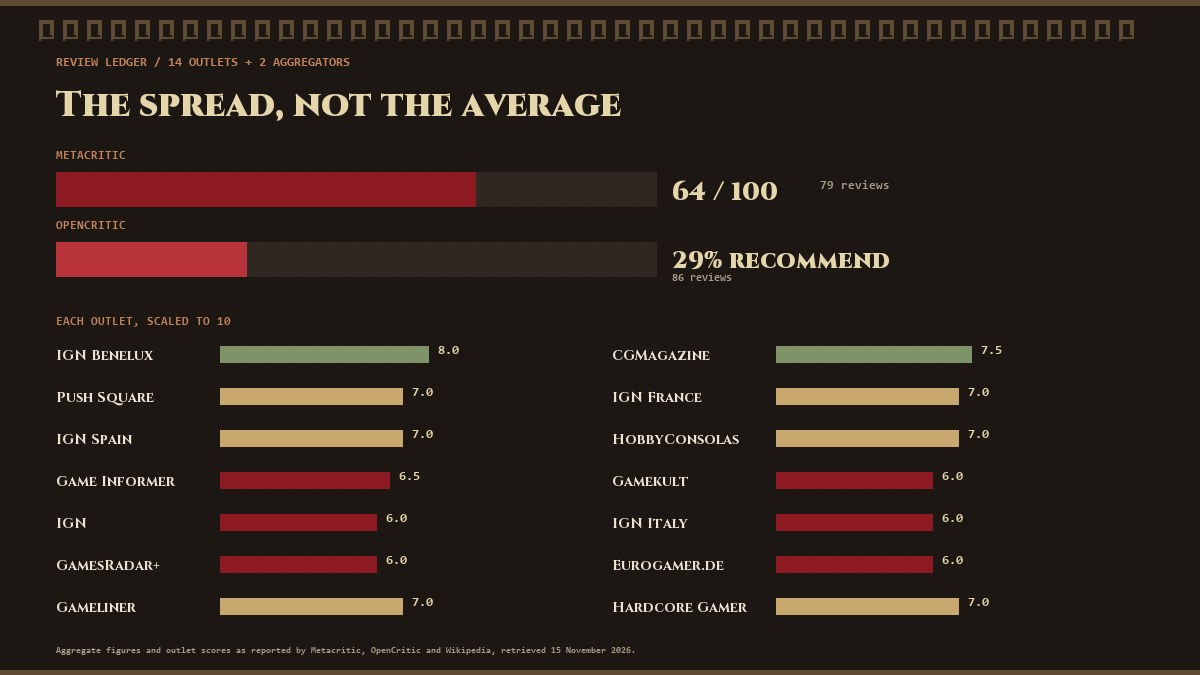
Every outlet on record
| Outlet | Score | On a 10 scale |
|---|---|---|
| IGN Benelux | 8/10 | 8.0 |
| CGMagazine | 7.5/10 | 7.5 |
| Push Square | 7/10 | 7.0 |
| IGN France | 7/10 | 7.0 |
| IGN Spain | 7/10 | 7.0 |
| HobbyConsolas | 70/100 | 7.0 |
| Gameliner | 3.5/5 | 7.0 |
| Hardcore Gamer | 3.5/5 | 7.0 |
| Game Informer | 6.5/10 | 6.5 |
| Gamekult | 6/10 | 6.0 |
| IGN | 6/10 | 6.0 |
| IGN Italy | 6/10 | 6.0 |
| GamesRadar+ | 3/5 | 6.0 |
| Eurogamer.de | 3/5 | 6.0 |
What the spread says
Three patterns, in order of how useful they are.
1. Nobody loved it and nobody hated it. The range runs from 6.0 to 8.0 on a ten scale. There is no 9 and no 4. A spread that tight around the middle is the signature of a competent game that did not surprise anyone — which is exactly what "mixed or average" means on Metacritic.
2. The 8/10 is an outlier, not a faction. A single 8 does not offset six scores at 6.0-6.5. When you see one high score and a cluster low, the cluster is the signal.
3. The regional IGN outlets disagree, which is informative. IGN Benelux 8, IGN France 7, IGN Spain 7, IGN Italy 6, IGN 6. Same franchise, same game, five different verdicts from sister outlets. That is a taste split inside one organisation, and it suggests the game's appeal depends heavily on what the reviewer wanted from it.
The criticism is consistent
This is the part that matters more than the scores, because it tells you whether the complaint applies to you.
| Theme | Who said it | In short |
|---|---|---|
| Metroidvania depth | Game Informer | Every element present, only at a base level or lower |
| Genre standard | IGN | Does not meet the standard of others in the genre |
| Feel | GamesRadar+ | Unsatisfying |
| Movement | Game Informer | Stiff; fast travel arrives too late |
| Combat animation | GamesRadar+ | Floaty and slow |
| Gear | GamesRadar+, IGN | Customisation exists but there is no incentive to use it |
And on the other side:
| Theme | Who said it | In short |
|---|---|---|
| Exploration | Eurogamer.de | Genuinely fun, solid genre work |
| Combat reliability | IGN | The most reliably compelling thing going on |
| Narrative | Game Informer | Moved by the ending; the strongest part |
| Lore value | Eurogamer.de | Worthwhile for fans for what it adds |
How to read that as a buyer
The two lists are not in conflict, they are describing different layers:
- The story layer was received well. Multiple critics specifically credited the narrative and the character work, including reviewers who scored the game low.
- The Metroidvania layer was received poorly, consistently, and by name.
- The combat sits in between: called reliable by IGN, called floaty by GamesRadar+.
If you are buying for the first layer, the aggregate score is misleading you downward. If you are buying for the second, it is accurate.
The score that is not in the table
There is also David Jaffe, the series' creator, who publicly criticised the game — calling it generic and arguing it does not reflect the licence, while allowing that the gameplay was serviceable. That is not a review score and does not belong in the table, but it is a data point that shaped the conversation around launch and it is part of the record.
Patch timing and score stability
All the scores above were recorded in February 2026, in the weeks around the PS5 launch on 12 February. The 16 November 2026 patch adds Hermes Mode and Erebus Mode and does not change the base game those reviews assessed, so the aggregates should be read as describing the game without those modes.
That matters if you are deciding today: no reviewer has assessed Hermes or Erebus, because they did not exist when the reviews were written.
What this page is not
It is not a re-scoring. This site has not reviewed the game and will not manufacture a score to sit alongside the real ones. It is a ledger — what each outlet said, collected in one place, with the pattern named.
Hermes Mode: rules, unlock code and split routingErebus Mode: surviving when every hit killsAll 594 collectibles, ranked by regionPlatinum roadmap: 36 trophies, one playthroughEvery boss, in the order you meet themSpear, shield and how attachments actually upgradeThree skill trees, one orb budgetGifts of Olympus and what each family doesAll 20 guides →