
Hermes Mode: rules, unlock code and split routing
What Hermes Mode is
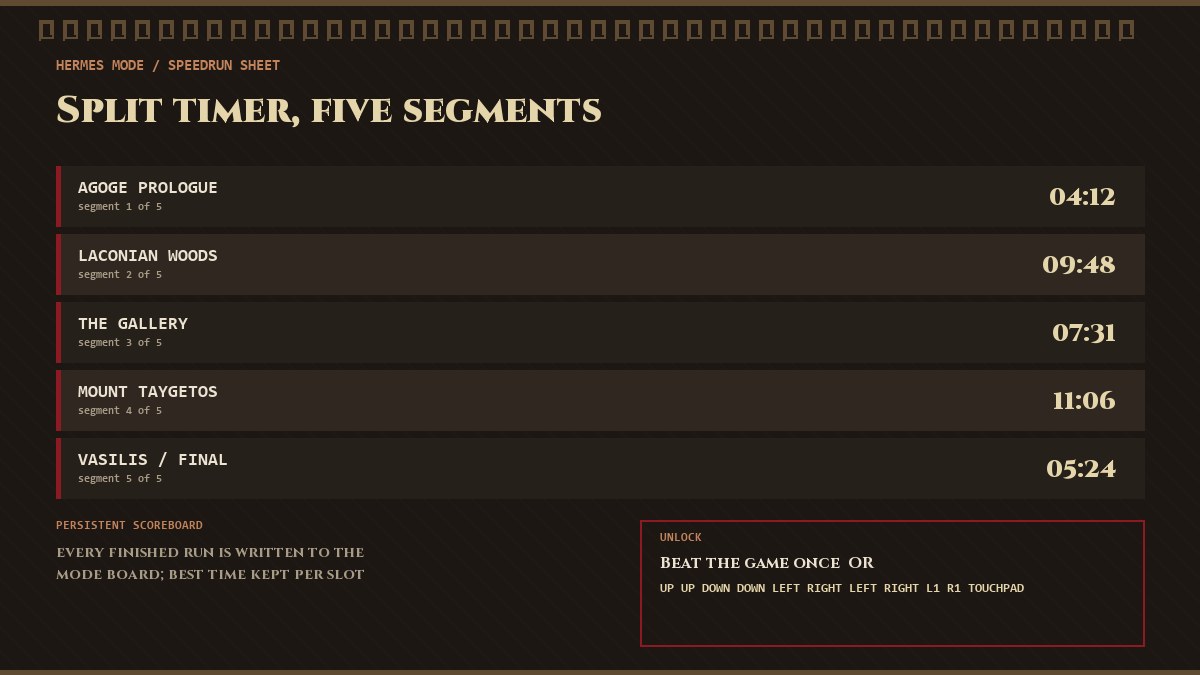
Hermes Mode is the speedrun mode added in the free 16 November 2026 patch. It ships a dedicated speedrunning toolkit: a split-based timer, a persistent scoreboard, and the surrounding tools a timed run needs. It is available on both PS5 and PS4 in the same patch.
Two ways in:
- Beat the game once. The mode then opens normally.
- Enter the official code in the start menu:
Up, Up, Down, Down, Left, Right, Left, Right, L1, R1, Touchpad.
That string is published by Santa Monica Studio in the PlayStation Blog post announcing the patch. It is a cheat code in the old sense — a developer-sanctioned input, not a leak and not a redeemable store code.
The rule that catches people out
Your mode is selected when you start a new game and pick a save slot. Once selected, the mode chosen for that save file cannot be changed.
That has three practical consequences for a speedrunner:
- You cannot convert an existing story file into a Hermes file. Practice runs and real runs are separate files.
- You cannot drop out of Hermes into a normal run mid-way to practise a section with more health. Every practice attempt is a fresh file.
- Because there is only one save slot and manual saves happen at campfires, your run's integrity depends on you remembering to save. A crash or a quit without a campfire save costs you the run.
What the split timer changes about routing
A split-based timer records the time at each segment boundary rather than only at the end. For a Metroidvania that means you plan in segments, not in one long attempt.
| Segment type | Why it becomes a split | What you gain |
|---|---|---|
| Story gate | Ends when the story hands you a required gift | Measures story pacing separately from clean-up |
| Traversal gate | Ends when a movement gift opens a shortcut | Exposes the cost of the route you chose |
| Boss gate | Ends on the encounter's end | Isolates fight consistency from movement |
| Region entry | Ends when you cross into a new region | Shows whether your route order is the slow part |
The point of splitting is diagnostic. A single final time tells you that a run was slow; five splits tell you which segment bled time. If your Laconia segment is stable and your Gallery segment is not, you do not need to practise the whole game, you need to practise one room.
Persistent scoreboard: what it is for
The scoreboard persists finished runs, so the mode keeps a record rather than showing you a single number at the end. For a runner that is the difference between "I think I am improving" and having the history to check.
Treat it as a personal ledger:
- Finish runs even when they are bad. A slow completed run is data; an abandoned run is not.
- Change one thing between runs. Route order, a boss approach, a movement gift timing.
- Compare splits, not totals, when you are diagnosing.
Planning a first Hermes run
You do not need a route map to start. You need an order of operations that respects what the game gates.
- Decide the run's shape first. Any% style (story only) and 100% style (with the 594 collectibles) are completely different runs. Pick one.
- Take the traversal gifts early. Movement gifts gate progress in a Metroidvania, so a route that defers them pays for it later in back-tracking.
- Learn where the campfires are before you optimise. A run that dies with unsaved progress is slower than a run that saves twice more.
- Fix your segment boundaries and never move them. If the splits change between attempts, the comparison is meaningless.
- Record the first clean run as your baseline. Not your best, your cleanest. Optimisation needs a floor.
What Hermes Mode does not do
It does not change enemy health, damage, or the story. It does not remove the campfire save requirement. It does not make Erebus Mode's one-hit rule apply. It is a measurement layer over the same game, which is why a Hermes run is a legitimate way to learn the map even if you never submit a time anywhere.
Should you start with Hermes or with the story?
For a first playthrough, no. The mode is a tool for people who already know the route; running it cold means the timer is measuring you reading. Play the story once, learn where the traversal gates are, then start a Hermes file with a route in mind.
The exception is a player who has already finished the game on PS5 and is picking up the PS4 version: you already know the map, so a Hermes file from the start is the right call.
Erebus Mode: surviving when every hit killsAll 594 collectibles, ranked by regionPlatinum roadmap: 36 trophies, one playthroughEvery boss, in the order you meet themSpear, shield and how attachments actually upgradeThree skill trees, one orb budgetGifts of Olympus and what each family doesOne save slot, campfires only, and a mode you cannot changeAll 20 guides →