
What IGN's 6/10 actually argued
What the score was
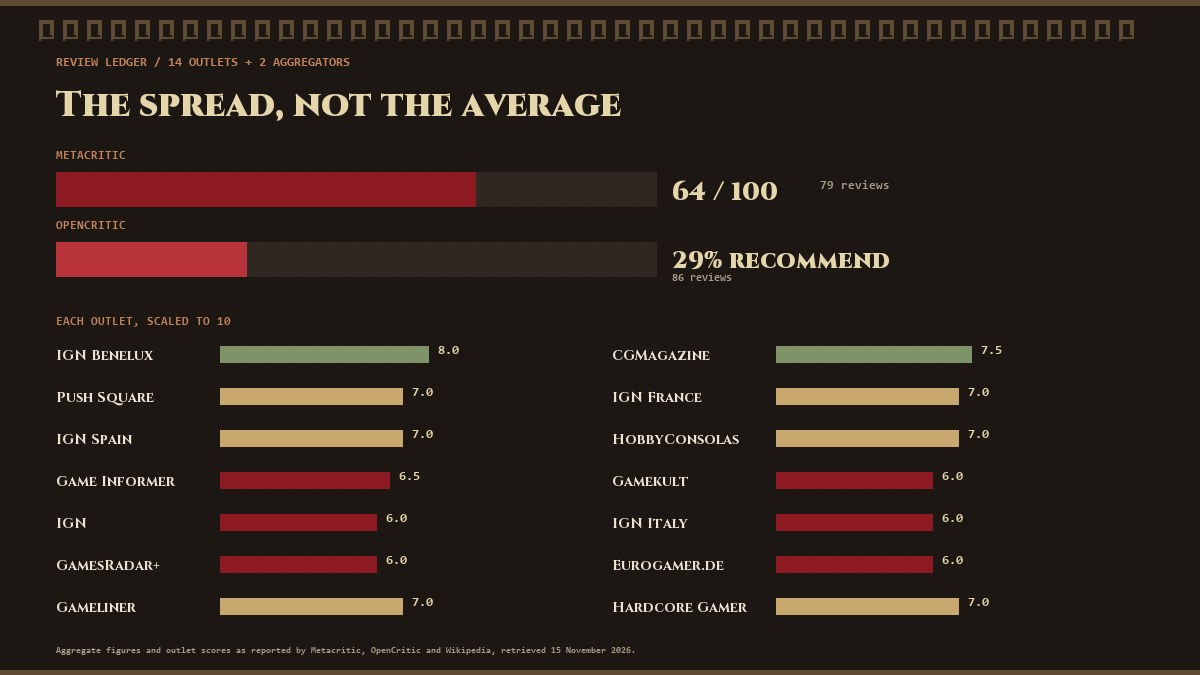
IGN scored God of War Sons of Sparta 6/10. That is a "mixed" verdict on their own scale, and it sits slightly below the Metacritic average of 64 — so it is not an outlier, it is on the pessimistic side of a pessimistic consensus.
What makes the review worth reading separately is the shape of its argument: it praises combat more than the aggregate does, and criticises the genre layer at least as hard.
The argument, in its own structure
The review makes four separable claims. They are worth separating because a reader who agrees with two of them and disagrees with two might still like the game.
Claim 1 — it does not meet the genre's standard. The comparison being made is to other Metroidvanias, not to other God of War games. That is the central charge.
Claim 2 — the combat is the best thing in it. In IGN's framing, combat is the most reliably compelling element. This is a genuine positive, and it is the one that most conflicts with the aggregate mood.
Claim 3 — Kratos' offensive options do not resemble the earlier games. A specific, checkable complaint: whatever this combat is, it is not the combat of the Greek or Norse eras translated intact.
Claim 4 — there is customisation but no incentive to use it. The ability and gear options exist; the game does not create pressure that makes you engage with them.
Claims 2 and 4 sit oddly together, and that tension is worth noticing: the combat is the strongest part, and the build system around it does not motivate engagement. Both can be true — a good core loop with a hollow progression layer on top.
Claim 3, examined
This is the most interesting one, because it is structural rather than a matter of taste.
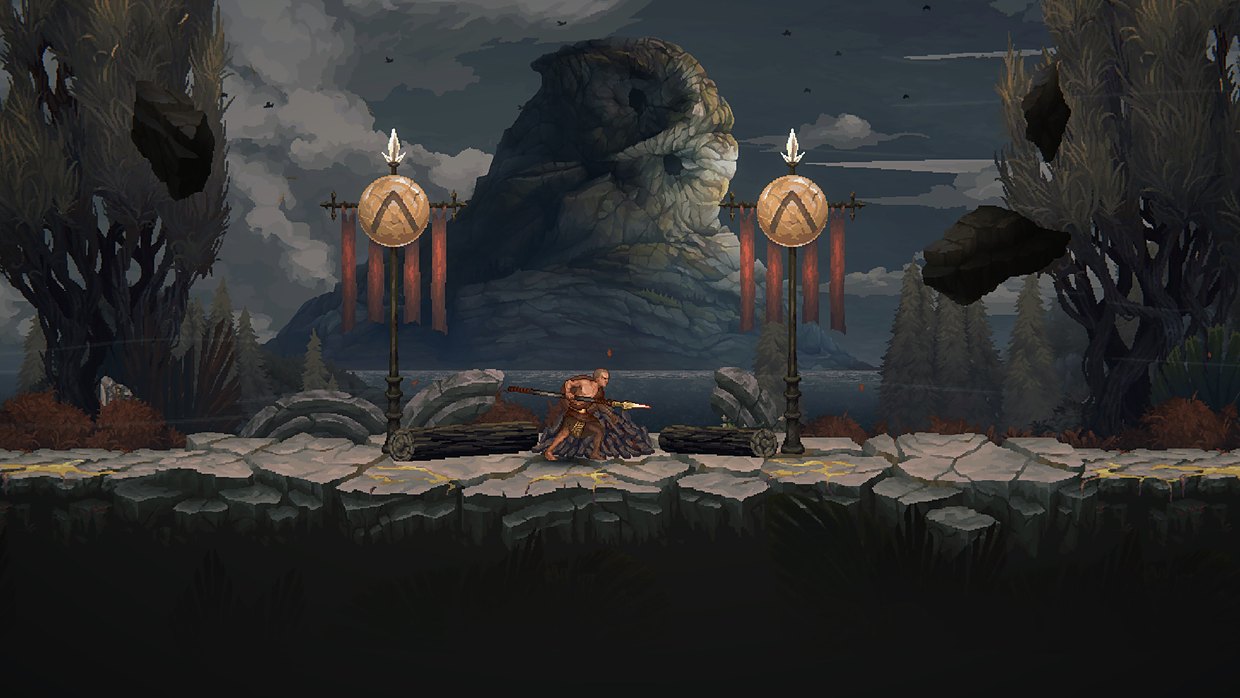
The game is set before Kratos receives the Blades of Chaos, so he fights with a spear and shield — the Dory and Aspis. A spear is a reach-and-thrust weapon and a shield is a block-and-bash tool. Neither moves like the chained blades, and the 2D perspective removes the third dimension that the earlier games' combat used for positioning.
So when the review says the offensive options do not resemble the earlier games, it is describing a design consequence rather than a failure of effort. Whether that is a problem depends on whether you wanted "God of War combat in 2D" or "the specific feel of Greek-era Kratos". Those are different asks, and the review is measuring the second.
Claim 4, examined
"Customisation without incentive" is a common failure mode and it is easy to check in play: if you can finish the game comfortably with your starting kit, the systems are decorative.
The game's actual systems are:
| Layer | What it offers |
|---|---|
| Spear attachments | Own upgrade path per attachment |
| Shield attachments | Own upgrade path per attachment |
| Belt of Tyche gouri | A third charm layer on one armour piece |
| Three skill trees | Offence, defence, movement, all on red orbs |
| Gifts of Olympus | Special and super attacks |
That is a lot of surface. The review's claim is not that it is absent, it is that nothing pushes you to explore it — which is consistent with a game whose difficulty does not require optimisation.
What the review did not assess
Two things, both by necessity:
- Hermes Mode and Erebus Mode did not exist when this review was written. They arrived in the 16 November 2026 patch.
- The PS4 version did not exist either; it launches 16 November 2026.
So the score describes the PS5 base game as it stood in February 2026. If Erebus Mode turns out to be the mode that finally makes the build system matter, that is a data point no launch review could have had.
The narrative, in the same review
Worth recording because it is the strongest part of the review's positive side: it credits the story as a rehabilitative portrait of a character the reviewer had no particular affection for, while finding the plot itself largely unengaging. That is a narrower compliment than "good story" — it is "the character work lands, the plot does not".
For a buyer chasing the canon gap, that is arguably the most useful sentence in the whole review.
How to use a 6/10
A 6 from IGN, on a game that other outlets scored between 6 and 8, is not a warning — it is a description. What it describes:
- If you want the genre's best-in-class execution, this is not it, and the review says so specifically.
- If you want God of War's story extended into a period nobody has covered, the review's own positive notes support that.
- If you want a 20-hour platinum at 4/10 difficulty, no review score is measuring that.
What this page is not
It is not a summary of IGN's article and does not reproduce its text. It is an analysis of the argument's structure — which claims are about taste, which are about design, and which parts of the game the review could not have assessed.
Hermes Mode: rules, unlock code and split routingErebus Mode: surviving when every hit killsAll 594 collectibles, ranked by regionPlatinum roadmap: 36 trophies, one playthroughEvery boss, in the order you meet themSpear, shield and how attachments actually upgradeThree skill trees, one orb budgetGifts of Olympus and what each family doesAll 20 guides →