
What it adds to the Greek saga
What "canon" means here
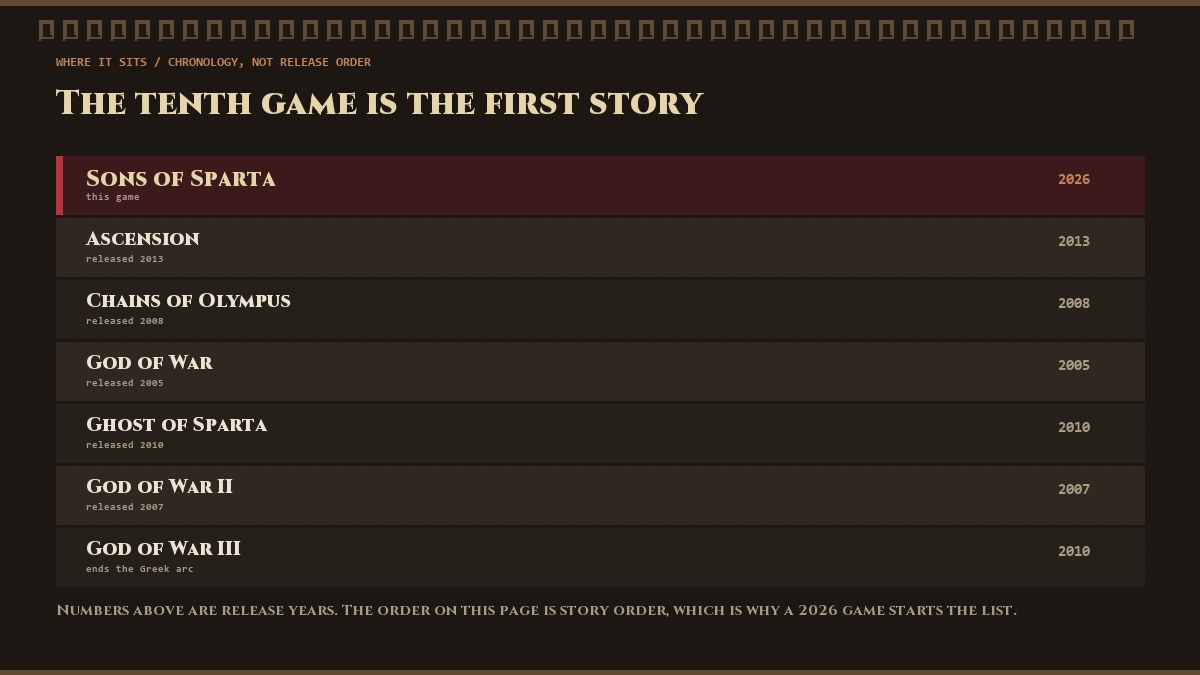
Sony's framing is specific: Sons of Sparta is a canon story written by the team behind God of War (2018), Ragnarök and Valhalla, set during Kratos' youth. Not a side story, not a spin-off in the dismissive sense — an entry that the rest of the series is meant to be consistent with.
That is a claim worth examining, because the game does three things to the Greek saga's established material.
1. It gives Deimos a life before the tragedy
Deimos is the wound at the centre of Ghost of Sparta (2010): the brother taken by Ares, the reason Kratos becomes what he becomes. In that game he is a backstory event that the plot reveals.
Here he is an eleven-year-old who wants to find his missing friend and who pushes his older brother out of his comfort zone. That is the game's actual contribution to the canon: not a new event, but a person where there had only been a fact.
If you know Ghost of Sparta, this is the part that lands. If you do not, it is still a story about two brothers.
2. It sets Kratos before he despises the gods
The game takes place before Kratos' relationship with the Olympians curdles. The directors' own note is that this younger version was more devout toward the gods than the Kratos of the later Greek games.
That is a meaningful characterisation choice, because it makes the Gifts of Olympus — the divine artefacts that carry your special attacks — coherent in-world. He is not stealing power from gods he hates; he is being given tools by gods he still believes in.
3. It fills the Agoge
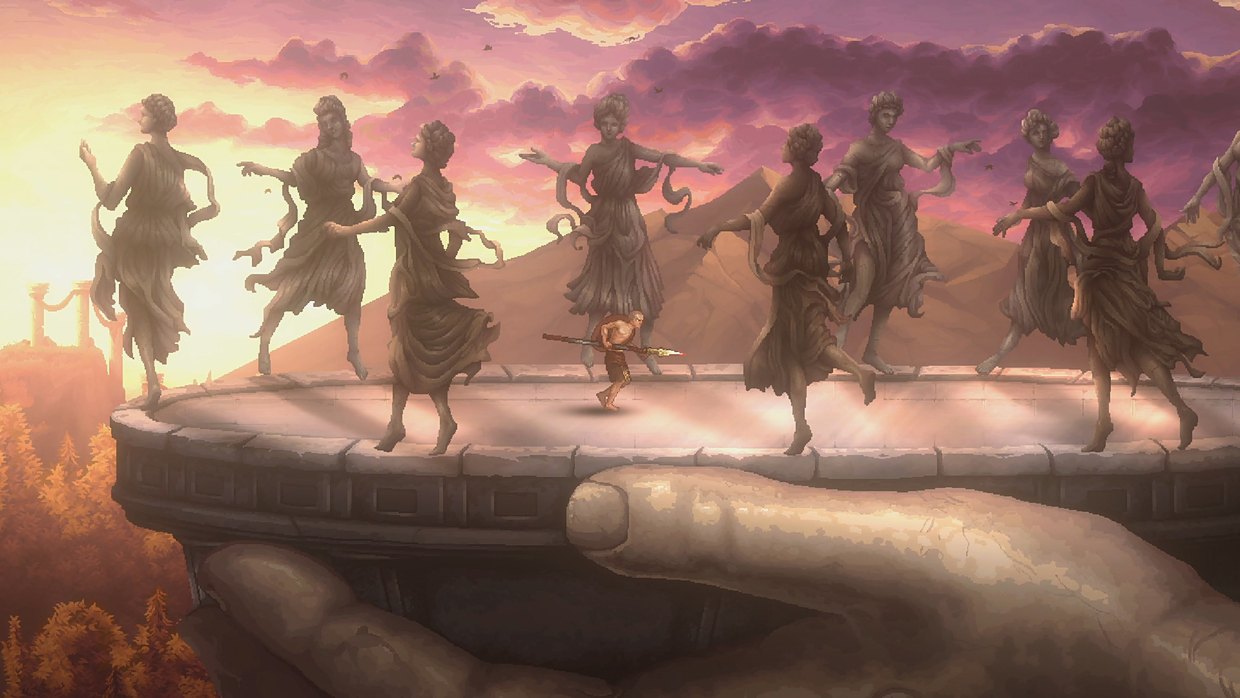
The series has referenced Spartan training for two decades without dramatising it. This game is set during it, with a headmaster (Konstantinos), a rival (Brontes), a comrade (Eis), and a missing cadet (Vasilis) whose disappearance is the plot's engine.
The Agoge setting is also why the weapons are a spear and shield rather than the Blades of Chaos: the story predates them entirely, so the series' signature weapon cannot appear.
What it does not do
Three things the game does not claim to be:
- It is not a remake or a reboot. The Greek era's existing games are untouched.
- It is not a bridge that changes later events. It is a prequel that explains, not one that rewrites.
- It does not resolve Deimos' fate. Ghost of Sparta already did that; this game is set before it.
The objection worth recording
David Jaffe, the series' creator, publicly criticised the game — calling it generic, arguing it does not reflect the licence, and describing the portrayal of young Kratos dismissively. He allowed that the gameplay was serviceable and said he was not opposed to a 2.5D entry in principle, citing other modern 2D revivals as examples he rated.
That objection is not a review score and does not change what the game is. It matters because it is the strongest form of the argument that "canon" and "in keeping with the series" are different claims: a story can be officially canon and still feel wrong to the person who defined the character.
Where the fans landed
The review consensus separated cleanly along this line, which is unusual:
| Layer | Reception |
|---|---|
| Narrative and characterisation | Credited, including by reviewers who scored the game low |
| Lore added to the series | Called worthwhile for fans by Eurogamer.de |
| Plot as a plot | Called unengaging or backgrounded by more than one critic |
| Metroidvania design | Criticised consistently |
So the canon contribution was received well even by critics who did not enjoy playing it. If the reason you are here is the story gap, that is the relevant finding.
How to get the most out of it
Two practical suggestions, both about ordering:
- If you have not played Ghost of Sparta, play it after this one, not before. The reveal about Deimos lands harder if you meet him here first as a kid.
- Do not read a plot summary first. The narrative is the part reviewers agreed works, and it is a 15-hour story — summarising it in advance trades the game's best asset for ten minutes saved.
What this page is not
It is not a plot recap and it does not spoil the ending. The point of this page is to place the game in the canon and record what it contributes, so you can decide whether that contribution is worth your money — not to spend the contribution itself.
Hermes Mode: rules, unlock code and split routingErebus Mode: surviving when every hit killsAll 594 collectibles, ranked by regionPlatinum roadmap: 36 trophies, one playthroughEvery boss, in the order you meet themSpear, shield and how attachments actually upgradeThree skill trees, one orb budgetGifts of Olympus and what each family doesAll 20 guides →